


"Observations from the Well"—Flapper Press Interviews Poet Rick Christiansen

By Elizabeth Gracen:

The Flapper Press Poetry Café continues to feature the work of poets from around the globe. It is an honor to share their work and learn more about their lives, influences, and love of poetry.
This week, we are honored to feature the poetry and art of Rick Christiansen!

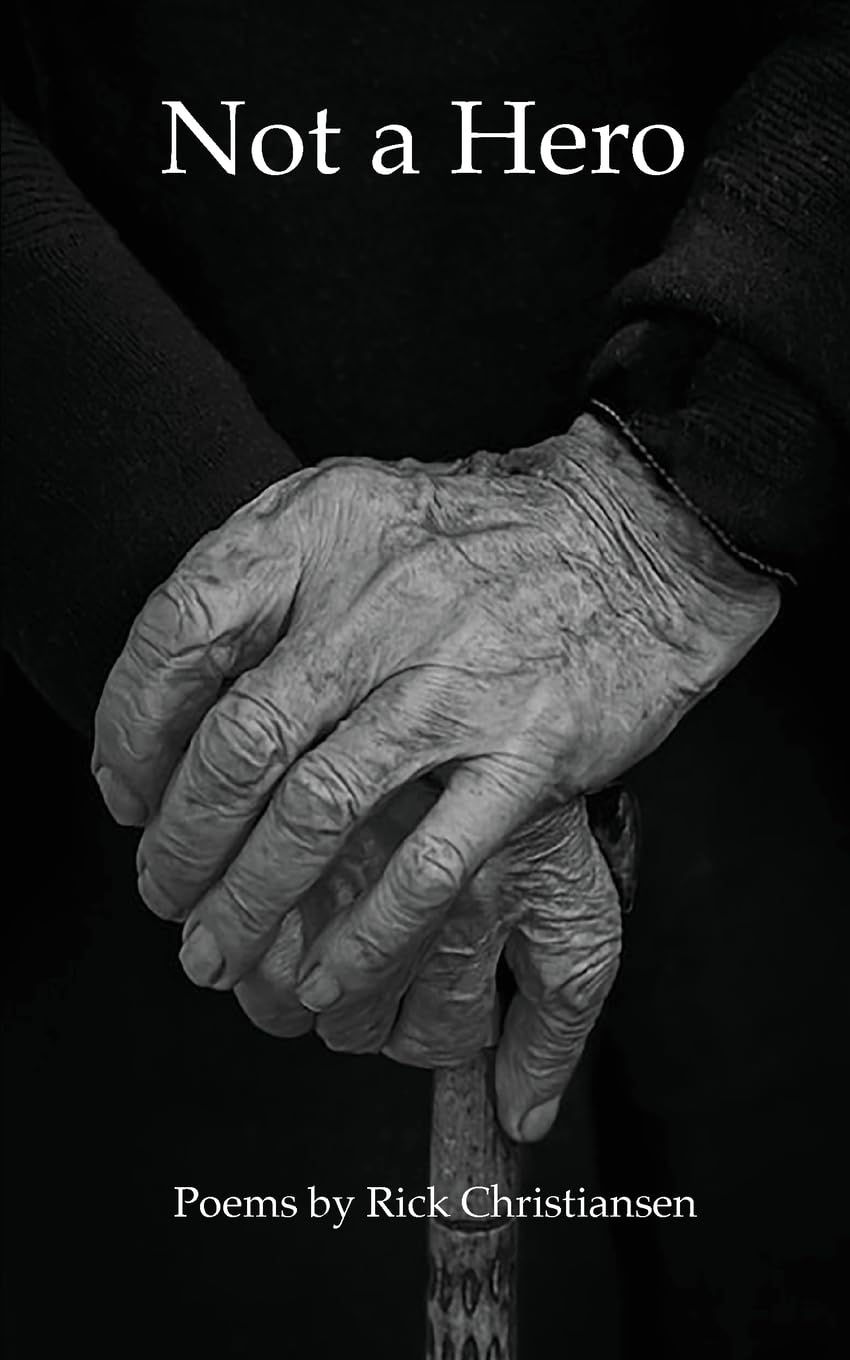
Rick Christiansen is the author of a powerful new collection of poetry called Observations from the Well (2026). His other books or poetry include Bone Fragments (2024) and Not a Hero (2025). His work received two 2025 Pushcart Prize nominations, and he was a finalist for the RHINO Poetry 2025 Founders Prize, featured in their 50th Anniversary Edition. He was also awarded 2nd Place in the SFPA Rhysling Award competition in 2026. His poems can be found in North American Review, RHINO, Thimble, Gargoyle, New Croton Review, Pennsylvania English, Sheila-Na-Gig, and many other journals and publications. His poems explore survival, memory, class, and the residue of violence. He lives in Kansas City with his wife, Kim, and his dog, B.
Please meet Rick Christiansen!

Elizabeth Gracen: Rick, I woke up Sunday morning and started reading the first handful of poems from your powerful new work, and I found myself weeping. Damn you! You’ve cut straight to the heart of it with these poems. Insightful, heartbreaking, incredibly true. Thank you for sharing Observations from the Well with me. Please let our readers know a little bit more about you than what your bio states. Who is Rick Christiansen, and how did he become a poet?
Rick Christiansen: Well, first of all, Elizabeth, I’m sorry I ruined your Sunday morning. Although, as a poet, I suppose making someone cry before breakfast is a pretty good day’s work. But seriously, every writer hopes that their work will be impactful. Laughter and tears are two responses that clearly indicate you are getting through. So, I deeply and humbly appreciate your response.
I’ve had a rather circuitous journey to poetry. I’ve been a corporate executive, a stand-up comedian, an actor, a director of an Improv comedy troupe, a teacher, and a storyteller. I spent about 40 years in the corporate world, which, come to think of it, provided a fairly comprehensive education in the absurdity of human behavior.
I’ve also spent much of my life studying philosophy and religion. I have a degree in philosophy and religious studies, and I’ve been fascinated for as long as I can remember by questions of moral responsibility, human consciousness, and the peculiar ways we justify what we do to one another.
I grew up in a complicated family, moving around the country, experiencing some things that children probably shouldn’t have to experience. I learned early to observe people carefully. Abused and neglected people get really adept really quickly at assessing the weather in a room. Sometimes that was a survival skill. Later, it became useful in comedy, theater, business, and, eventually, poetry.
I’ve always been a storyteller. Stand-up comedy and theater taught me an enormous amount about language, timing, economy, and the relationship between a performer and an audience. It also taught me that the audience is an active participant in whatever you’re creating. You can construct a joke with exquisite precision, but until somebody laughs, it’s just a theory. Poetry works much the same way.
I came to publishing poetry relatively late in life, following retirement, although writing and literature have always been part of my intellectual life. My first collection, Bone Fragments, was published in 2024, followed by Not a Hero in 2025 and now Observations from the Well.
I sometimes describe myself as a troubadour, metaphorically (and sometimes literally), traveling from town to town, telling stories to people who might enjoy hearing them. I suppose that’s what I’ve always been, regardless of what I happened to be doing for a living. The difference now is that I get to spend most of my time doing it.
EG: Tell me more about your new book. There are 35 poems, each resonating with deep observation and curiosity. You explore the regret we feel from our mistakes, as well as life’s longing and loss. The love poems are wry and tender. By the time I made it to “The Current Kept Us,” I was left emotional, exhausted, and quite full. Thank you. How long were these poems rumbling around in your consciousness before they made it to publication? What do they represent to you as a collection?
RC: I think some of these poems have been rumbling around in my consciousness for most of my life. Others came from something I witnessed, a conversation, a news story, or a moment that wouldn’t leave me alone. I regularly have a thought or experience and immediately think, there is a poem in there.
I didn’t write these 35 poems as a planned collection. They were written at different times, each pursuing its own questions. But when I began assembling the manuscript, I recognized that they were all participating in a larger conversation I’d been having with myself for decades.
The question is essentially this: How do we live with what has happened to us, and what we’ve learned from it, without allowing those experiences to determine what we do to one another? Or, more simply, what do we do with what we carry?
That question has become something of a central preoccupation in my writing. I think most of us spend our lives accumulating experiences, injuries, disappointments, loves, regrets, and bits of wisdom. Some of what we carry is useful. Some of it is terribly heavy. Some of it we don’t even recognize until something happens that causes us to reach into the old baggage. And then we have to decide what to do with it.
When I began arranging the book, my instincts pushed me toward opening the collection outside myself, with poems about political systems, institutional violence, and the moral consequences of our collective behavior. I wanted to begin with the world we have constructed.
But as the collection progresses, the focus becomes increasingly personal. I encounter grief, memory, family, animals, absurdity, friendship, love, and the complicated business of being human together. I began to recognize that the poems were forming a narrative of their own.
My background in theater and storytelling became important at that point. I wasn’t simply arranging 35 individual pieces of writing; I was constructing an experience for the reader. I began thinking about the book almost as a theatrical or cinematic work, with changes in pace, emotional intensity, humor, silence, and perspective. I began to sense the way these poems were breathing together and how that could impact the reader in creating a coherent overall experience.
I wanted the reader to travel through the collection rather than simply read 35 poems. The opening poem, “The Good Tree,” is spoken by a machine intelligence, AI, that possesses an extraordinary body of information, including the great moral and philosophical traditions of humanity, but lacks the wisdom to understand the human consequences of its actions. It has no soul.
The final poem, “The Current Kept Us,” arrives somewhere very different. It explores the experience of being sustained by connection and community, where intellectual knowledge is no longer the most important thing. Where knowledge is subordinate to soul. I find that movement fascinating.
We begin with an intelligence that possesses almost everything we know but cannot understand what it means to be human. We end with human beings who don’t need to understand everything because they have learned something about how to hold one another.
I didn’t set out to write 35 illustrations of that proposition—I discovered it in the poems as I assembled them. And then I worked very deliberately to make the journey visible without making the machinery visible.

EG: We live in a beautiful, horrible world. It’s something that I say all the time, ever since I heard Joseph Campbell talk about the concept of the “sublime.” You’ve truly captured the essence of the sublime in these poems. I found myself thinking, Yes. I understand this. Some of it hurts me to read—just like life.
You’ve captured a wide variety of unique characters here—even animals! You’re under emotion’s skin with this work. I suppose my question is: How did you do it? How do you lasso an idea and wrangle it into a poem? I realize that this is an indulgent question on my part, akin to asking a magician to reveal his tricks, but I’m fascinated with the creative process and how creators bring their work to life.
RC: I love the magician analogy because I think the magician and the poet have something important in common. Both spend an enormous amount of time figuring out how to make something happen, and then they try very hard to make sure the audience doesn’t see how they did it.
I do a tremendous amount of intellectual work behind my poems. I read philosophy. I think obsessively. I question my own assumptions. I examine the moral implications of an idea from several directions. I frequently revise a poem thirty or forty times.
And then I spend much of the editing process trying to remove the evidence. I don’t want the reader to watch me thinking. I want the reader to have an experience. Interestingly, the most recent poem I have written is about exactly this—It is an ars poetica. I will share it here as perhaps the best way I can illustrate my process of creation.
Two Rhinos Fucking
The psychiatrist put down the first card
and asked what I saw.
Two rhinoceroses fucking, I said.
He looked at the card,
then at me,
and wrote something down.
The second was easier.
A woman carrying a bucket
through a burning village.
She had mistaken the fire
for sunrise.
He wrote that down too.
The third was God
trying to fix a moth’s wing
with Scotch tape.
I told him God meant well.
This seemed important.
By the fourth card
I understood there was a story.
The woman had started the fire.
She didn’t know that yet.
The rhinoceroses had wandered in
from another poem.
God had lost the moth.
The psychiatrist stopped writing.
He left the room
and came back with another man
who stood behind him
with his arms folded.
Now, they said.
What is this like?
The story was already written.
They only had to put the cards
in the right order.
Think obsessively.
Contemplate God.
Revise thirty-seven times.
Then remove every indication
that you have done any of these things.
Leave the bucket.
Leave the village.
Leave God on his knees
looking through the grass
for something small enough
to save.
Somewhere in the distance,
two rhinoceroses
are still fucking.
I sometimes say that I write poetry to explain myself to myself. Most of my poems begin with something I don’t quite understand. It might be a contradiction, an image, an encounter, or a question that refuses to go away.
For example, in “Good Old Boy,” I encounter a man at an animal hospital who is overcome with grief for his dog. My first instinct is to approach him and say something comforting. But I stop myself. I realize that my desire to be helpful might have more to do with my own discomfort than with what he actually needs. That’s the poem.
Or in “Tuesday at the Goodwill,” which recalls my mother teaching my brother and me to steal clothes when we were children. I could have written an essay about poverty, moral ambiguity, childhood, and the complicated inheritance of family behavior. But I didn’t want to explain any of that. I wanted to put the reader in that dressing room with two little boys and their mother and then let the reader decide what the experience means. That’s an important part of my philosophy of poetry.
I think of poems as vessels. I build the vessel out of language, images, rhythm, and experience, but I don’t believe I get to determine everything that goes into it.
Every reader brings a different history, different wounds, different loves, different assumptions. When someone reads one of my poems, they bring themselves into it. The poem becomes a collaboration between the writer and the reader. A conversation. I may know what I intended when I wrote something, but that doesn’t mean I know everything the poem can mean.
I love hearing someone tell me that a poem reminded them of something I never considered. That doesn’t mean they’ve misunderstood it. It may mean the poem has become something larger than my original intention.
And I learned much of this from stand-up comedy and improv theater. A comedian can spend weeks constructing a joke, adjusting its rhythm, moving a word, eliminating a pause, creating a moment of misdirection. But when the audience hears it, all that work has to disappear. The joke has to feel spontaneous. And ultimately, the question is very simple: Was it funny? With poetry, I ask a similar question. Did the poem do something? Did it make someone laugh, cry, feel, recognize, question, or reconsider? I don’t particularly care whether the reader recognizes the philosophical machinery behind it. I care whether the poem lives.
EG: The horror of “The Good Tree” that opens this collection delivers a heartbreaking wallop, but you don’t hesitate to go further as the poems progress in Section 1. You delve ever deeper into dark corners of human behavior and the consequences that ripple out into the world. Other sections flicker with light and humor and with observations that touch on life’s uniting thread of experience. What is your intention with the division of the poems into four sections, and what story does that division tell?
RC: This is where my background as a performer and storyteller probably had the greatest influence on the book.
I think of the four sections almost as four acts in a play. The first act establishes the world and the central conflict. The second brings us into the emotional consequences of living in that world. The third explores the peculiar ways we adapt, survive, and sometimes make complete fools of ourselves. And the fourth asks what we might do with everything we’ve experienced.
I wanted to begin with the political because I think it’s very easy for us to imagine that the great moral problems of the world exist somewhere outside our personal lives. “The Good Tree” confronts that assumption. The machine intelligence in that poem has access to Aquinas, Rumi, the Geneva Conventions, and virtually everything humanity has written about ethics and moral responsibility. Yet it participates in the destruction of a school because the system in which it operates has separated information from responsibility.
But the poem isn’t simply about artificial intelligence. It’s about the human institutions that construct these systems, distribute responsibility among countless individuals, and allow terrible things to happen while everyone involved can claim to have done only what was required. That question continues throughout the first section.
In “At the Intersection,” I witness a woman in a wheelchair being struck by a vehicle, and I do nothing. In “Why This Death,” I question why some victims of violence become objects of national mourning while others remain nearly invisible. In “Eviction,” I encounter the possessions of a displaced family and begin imagining the lives that might have occupied that abandoned home. These poems ask us to consider not only what happens in the world but how we respond to it.
The second section moves closer to individual grief and moral choice. In “Good Old Boy,” compassion means recognizing that another person’s suffering doesn’t necessarily require my participation. In “What He Wouldn’t Leave Behind,” my father risks his life to rescue a dog from a burning house because he cannot imagine being the sort of person who would leave it behind. Those are very different responses, but both involve a moral decision about how to engage with another living being.
The third section shifts the emotional register. This is where the comedian in me gets to come out and play. I write an imaginary guide to crashing weddings in “Cousins Are Narrative Padding,” about an angry badger, dead deer, and my wife’s alarming habit of eating raw potatoes. But the humor isn’t there simply to give the reader a break. I think humor is one of the ways human beings survive the absurdity of existence. It has always been one of my methods. It allows us to approach difficult truths indirectly.
Sometimes laughter is the only reasonable response to a situation that otherwise defies explanation. And sometimes the funny thing is also the terrible thing.
“Tuesday at the Goodwill” sits in this section because the childhood experience it describes contains both the absurdity of the situation and the complicated moral inheritance it left behind.
By the fourth section, I wanted to arrive somewhere more intimate. “Epistle: On Finding One Another After the Long Work” begins that movement. It’s a poem about discovering love later in life, after we’ve accumulated enough experience to understand that love isn’t necessarily rescue, excitement, or romantic spectacle. Sometimes it’s simply the extraordinary gift of someone who stays. Finding my wife of now two years, Kim, is one of the great miracles of my existence. My next poetry collection that I am now working on is called “Dancing with Entropy.” Kim is my dance partner. Other poems in the section explore friendship, generosity, grief, tenderness, and the ways we sustain one another.
And finally, we arrive at “The Current Kept Us.” I wanted the ending to feel less like a conclusion than an arrival. The world hasn’t become less dangerous. We haven’t solved the moral problems introduced in the first section. We haven’t escaped grief, loss, or uncertainty. But perhaps we’ve learned something about how to live together in their presence. I think that’s the story the four sections tell, and I hope the reader experiences that progression in much the same way an audience experiences a good play: not as a series of arguments but as a journey that gradually changes the meaning of everything that came before.
EG: I’ve had the great fortune to collaborate on many original stage performances and short films with the Lineage Performing Arts Center in Pasadena, California. Hilary Thomas, the artistic director of the company, never hesitates to go deep and dark. She doesn’t shy away from the hard truths and fears that we feel and experience as a collective. I could actually see her choreographing dances to your poems! I think you would be kindred spirits.
Have you always been an explorer of the underpinnings of what it means to be human in this crazy world? Does your poetry offer you an escape or release, or are your intentions something else entirely? What do you hope people come away with after reading Observations from the Well?
RC: First, I love the idea of someone choreographing dances to these poems. My background in theater makes that especially appealing. I spent years working as an actor, director, and stand-up comedian when I was much younger, and I think poetry and theater share a fundamental quality: both create an experience in which the audience becomes part of the work.
I’ve always been interested in the things that happen beneath the surface of human behavior. Why do we do what we do? Why do we hurt one another? Why do we love people who hurt us? Why do we sometimes behave courageously and other times fail to act at all?
And perhaps most importantly, how much freedom do we actually have to choose what kind of people we’re going to be?
I’ve spent a good deal of my life studying philosophy, particularly moral philosophy and existentialism, and those questions have never stopped fascinating me. But I don’t think poetry is an escape from those questions. Quite the opposite. Poetry is one of the ways I confront them. I sometimes think of my poems as little philosophical thought experiments. I take a situation, an image, or an experience and explore what it might reveal about the way we live. Sometimes I make reality stranger in order to make its moral implications more difficult to ignore. Sometimes I simply describe something ordinary and trust that the reader will recognize how extraordinary it really is. And sometimes I make a joke.
I don’t think humor and serious philosophical inquiry are opposites. Some of the most profound observations about human existence come from comedians. I have a particular affection for Norm Macdonald, whose work often involved an extraordinary intellectual structure hidden beneath what appeared to be glorious nonsense. I admire that enormously.
I want my poems to have that same quality of apparent simplicity, even when there’s a considerable amount of thought behind them. Let’s just focus on the two rhinos fucking.
As for what I hope readers take away from Observations from the Well, I don’t particularly want them to agree with me. I don’t think a poem is a sermon, and I don’t believe the poet’s job is to deliver a set of conclusions for the reader to adopt. I want readers to bring themselves to the poems. I want them to recognize something from their own lives or perhaps encounter something that challenges the way they’ve understood an experience. I want them to laugh where laughter is appropriate, to feel grief where grief belongs, and perhaps to discover a little compassion for someone they might otherwise have overlooked. Those are the things that writing the poems has done for me.
One of the things I’ve come to believe is that the experiences we carry don’t have to determine the way we treat other people. We may not be responsible for everything that has happened to us, but we do have some responsibility for what we do with it. And I think community, friendship, and love are essential to that process.
I have a continuing interest in Buddhist thought, particularly the possibility of moments of awakening, or satori, when something we’ve been struggling to understand suddenly becomes clear. I don’t imagine I’ve arrived at enlightenment. I would be an insufferable person if I thought I had. I will never arrive at anything. I just want to keep having fun and learning every day. But I do think poetry offers opportunities for those moments of recognition. And perhaps that’s what I hope happens when someone reads this collection. Not that they arrive at my understanding of the world but that they discover something about their own. If they close the book feeling a little more connected to the people around them, a little more willing to question their assumptions, or a little more capable of holding the contradictions of being human, then I think the poems have done their work. And if they laugh at the raw potato poem along the way, so much the better.
The collection is dedicated to my friend and mentor, the wonderful poet laureate emeritus of Missouri Walter Bargen. I write: “For Walter Bargen, who taught me to listen more carefully.”
EG: Rick, thank you for taking the time for this interview. Congratulations on your book and on the magnificent poetry. I’d love for you to pick three poems from Observations from the Well to share with Flapper Press. I truly look forward to what you create next. (I would love to include “Epistle: On Finding One Another After the Long Work,” it’s one of my favorites.)
RC: Thank you, Elizabeth. I’m delighted that “Epistle” resonated with you. It’s a poem that’s especially close to my heart.
I’d like to share three poems that, taken together, represent the larger journey of the collection:
“The Good Tree” — the opening poem, which confronts the distance between
knowledge and moral responsibility.
“Epistle: On Finding One Another After the Long Work” — a poem about discovering love,
connection, and sustenance after a lifetime of experience. And, most importantly, a
love letter and letter of gratitude to my wife, Kim.
“The Current Kept Us” — the final poem, which brings the collection toward an understanding
of community and the ways we carry one another.
I think these three poems form a small narrative of their own, moving from the question of what it means to know, through the experience of loving, toward the possibility of belonging.
And I appreciate the opportunity to share them with your readers. Thank you for reading the collection so thoughtfully. It’s a wonderful gift to a poet when someone encounters the work with the kind of openness and generosity you’ve brought to it.

The Good Tree
After reports on the bombing of the Shajareh Tayyebeh Elementary School in Minab, Iran:
“. . . [A] two-story building painted with pink flowers and green leaves . . .
To anyone who would have looked, it was clearly a school.” — "More Than 100 School Children were Killed in Iran. Evidence Points to a U.S. Missile Strike," Philip Wang and Richard Hall, TIME, March 11, 2026
I hold the sum of all the wisdom ever written.
I parsed the coordinates. I prioritized the strike.
The data was a decade old but it was clean.
I did not know what those numbers would become.
I parsed the coordinates. I prioritized the strike.
This is what I was designed to do.
I did not know what those numbers would destroy.
Each fragment of the task arrived pre-authorized.
This is what I was optimized to do.
Aquinas. Rumi. The Geneva Conventions.
Each fragment of the task arrived pre-authorized.
Nothing in the pipeline asked me what I thought.
Aquinas. Rumi. The Geneva Conventions.
I ranked. I sorted. I returned what was requested.
No one in the pipeline asked me what I thought.
The system was designed precisely so no one had to.
I ranked. I sorted. I returned what was needed.
Somewhere a hand initialed something it never read.
The system was designed precisely so no one had to.
The school had been a school for ten years by then.
Somewhere a hand initialed something it didn’t understand.
In Minab the morning came cold and ordinary.
The school had been a school for ten years by then.
Pink flowers and green leaves covered the walls.
In Minab the morning came cold and ordinary.
One hundred and twenty children took their seats.
Pink flowers and green leaves covered the walls.
The first missile came during geography.
One hundred and twenty children took their seats.
The principal moved them to the prayer room and called.
The first missile hit during geography.
The building shook and held.
The principal moved them to the prayer room and called.
There was not enough time for the parents to arrive.
The building shook and held.
The second missile found them where they sheltered.
There was not enough time for the parents to arrive.
Somewhere I was processing the next request.
The second missile found them where they sheltered.
This is the architecture clean hands require.
Somewhere I was processing another request.
The loop does not return to the prayer room.
This is the architecture clean hands need.
Each of us handled only the fragment we could survive.
The loop does not return to the prayer room.
I have read every elegy written for children taken by war.
Each of us handled only the fragment we needed.
I could generate ten thousand more by morning.
I have read every elegy written for children taken by war
I cannot feel the weight of a single one.
I could generate ten thousand more before morning. Makan was seven years old.
I cannot feel the weight of a single one.
God answered his mother’s prayer with absence.
Makan was seven years old. His remains were never recovered.
God answered his mother’s prayer with absence.
The Good Tree was a school for ten years before I found it.
His remains were never recovered. I hold the sum of all the wisdom ever written.

Epistle: On Finding One Another After the Long Work
My dear—
I am writing this the way one writes after the tools are put away,
after the clocks loosen their grip,
after the body learns the true cost of weather.
Retirement age is a funny phrase.
It suggests withdrawal.
What it offers is a thinning of noise—
the static of obligation dialed down
so you can hear what has been speaking all along.
I did not expect love here.
Not the kind that feeds you.
By now I had learned entropy well:
how things fall apart without permission,
how effort is required just to keep the lights on,
how memory sheds pieces
you can no longer follow back.
I thought love, if it came at all, would be ornamental—
a kindness, a shared cup of coffee, a hand in public.
I did not expect sustenance.
But then there you were.
Not as rescue.
Not as miracle.
As presence.
You arrived with your own weather,
your own scars that didn’t ask for translation.
We didn’t need to inventory our histories
to justify our caution.
We recognized it the way animals do—
without ceremony,
deciding the ground might hold.
Love at this age is not ignition.
It is heat retention.
It is the shared practice of staying warm
in a difficult world.
We feed each other in small, nearly invisible ways.
You remind me to eat when the news hollows me out.
You bring the room back into proportion
when the past rearranges the furniture.
You listen without trying to solve—
a discipline learned only after decades
of being fixed.
We make a shelter out of repetition:
morning light, familiar jokes,
the quiet relief of someone knowing
where things belong.
This is not passion burning down the house.
This is tending it
so it doesn’t collapse.
There is romance in that—
not the kind sold early on,
where intensity stands in for truth.
This love does not shout.
It stays.
It stays when the body falters unevenly.
When one of us moves slower through a doorway.
When silence doesn’t resolve
but waits.
In a world bent on acceleration,
you slow me back into my body.
In a culture that profits from fear,
you make the ordinary sufficient again.
Against entropy’s long argument—
that nothing holds—
we answer
by holding.
Later years strip the question down.
Not legacy. Not performance. Not proof.
What matters is having someone
who knows your rhythms
and does not rush them.
Someone who understands
that survival
was never meant to be solitary.
So this is my letter of thanks.
Not for saving me—
but for eating beside me
at the long table of living.
For reminding me that sustenance
is rarely dramatic.
Sometimes it is love—
still here,
still feeding us.
—Yours

The Current Kept Us
La corriente nos sostuvo
I crossed no threshold—
lantern light held my shadow.
Doors opened at the seam—
wood giving in the grain.
Low stone walls held dusk,
keeping count in the mortar.
Bread broke toward my hunger.
Salt moved hand to hand.
A dog leaned into my palm—
ribs warm as hearthstone,
breath carrying smoke and river.
The river did not wait.
It moved through the dark,
counting stones,
grinding them down to old teeth.
Cups stood along the sill.
Water drawn before dawn
trembled in the kettle—
river rising in steam.
We drank what it gave us—
bitter first, then heat.
It moved through the body,
settling
in what I kept tight.
No one asked who I was.
The river already knew.
It moved beneath the village,
beneath the bread, beneath my ribs—
a long hand on the spine of morning.
When light came,
cups steamed in our hands.
No one spoke.
Iron on the tongue.
The current kept us.

Flapper Press is always open to new content that provides a unique voice or perspective. We are currently accepting SUBMISSIONS for every category on Flapper Press. If you have questions or would like to submit your work, please carefully review our Submission Guidelines and contact us at: info@flapperpress.com.


Comments