


Flapper Press Features the Contemplative Art & Poetry of Chris Biles

By Elizabeth Gracen:

The Flapper Press Poetry Café continues to feature the work of poets from around the globe. It is an honor to share their work and learn more about their lives, influences, and love of poetry.
This week, we are honored to feature the poetry and art of Chris Biles.

Chris Biles (she/her) is a writer/artist in Washington, D.C., where she enjoys playing with the light and the dark and losing herself in music, anything outside, and some words here and there. She dabbles in various visual art forms, plays jazz drum set, received Best of the Net and Pushcart Prize nominations for poetry in 2025, and is published in print and online. You can find her at marks-in-the-sand.com, on Instagram @marks.in.the.sand, or out walking the city streets.
We reached out to Chris to talk about her hybird approach through poetry and art.
Please Meet Chris Biles!
"Shaped by uncontrollable forces, we are everchanging. We consist of hard metals, etched; of sands shifting with whispering winds, sinking, settling; of flowing magma reaching for release, lava searching for cool waters. We are dark and the light, and all the grayness born by the two. We are compositions of loneliness and belonging; exuberance and grief; madness and vindication; hope. We break, are remade, then are broken again—from order, from chaos, the pieces make up the whole. We are what the world makes us. We come together eventually in one way or another. And in the end, we are marks in the sand; ash on the wind.” — Chris Biles

Elizabeth Gracen: Chris, first of all, thank you for sharing your work with Flapper Press over the years. Your poetry is powerful and straightforward, dealing with the important issues of the collective as well as the emotional impact that reverberates through it. Please tell our readers a bit about yourself and how you became a writer, poet, and artist.
Chris Biles: Thank you, Elizabeth. I'm very excited to be featured by Flapper Press and in conversation with you. I started writing poetry in high school and had some wonderful English teachers to light the way. I especially found inspiration from units on Edgar Allan Poe, Emily Dickinson, and also the Spoon River Anthology (shout out to Mrs. Henry!). That class really piqued my interest and started me on the path. I also took creative writing courses throughout my time at university, which presented the chance to stretch myself in new ways, especially with courses on short stories and poets of the natural world. It was at university that I also enjoyed the exhilaration of my first publications and writing awards. I wrote here and there during the years following uni but really didn't see growth in my writing skills until moving to Washington, D.C., where I really started to try polishing and publishing my work during COVID. Virtual participation in the D.C. writing community led to in-person open mics, readings, workshops, and more in 2022 and on.
I can't say enough about how fulfilling it is to be a part of the D.C. writing and poetry community. It's inspiring, accessible, encouraging, and rewarding thanks to the wonderful people.
I've dabbled with visual art forms since high school as well, with my most memorable experiments being a pencil drawing of my family's cat, Barney, and a photo composition of a cactus and a pincushion, which ended up receiving a National Scholastic Art and Writing Awards Gold Medal. I've always enjoyed photography and had amazing opportunities to travel to many parts of the U.S. and Africa for beautiful and interesting subjects. I started to work more on my experimental drawings while I was living in Tanzania and use the activity as a sort of meditative practice—breaking the page up with different lines and then filling the spaces in different ways with whatever images are with me at the time. Just recently, I returned to experimenting with linoleum block printing and am excited to keep working with that medium.
While poetry and art were never my main focus academically, I count myself lucky and grateful to find time to devote to the act of creating and to further developing what talents I possess. I think of myself as a passionate dabbler in many forms of art, and plenty of folks have called me a Renaissance person.
EG: In the preface to the work featured in this article, you say, “We are compositions of loneliness and belonging; exuberance and grief; madness and vindication; hope. We break, are remade, then are broken again—from order, from chaos, the pieces make up the whole.” These words speak to the essence of what it means to be human. Your work holds space for some of the heavy truths we all face, and in particular, you are interested in the emotional life of those who find themselves pushed to the margins. Can you share some of your process when it comes to approaching your investigation into these complicated subjects and how you transmute your findings into art?
CB: I've lived in, and travelled to, a variety of places, and that's exposed me to many different ways of life—different cultural norms and societal structures/pressures and, naturally, different values and perspectives. Some of the people and places and perspectives that shaped my understanding of the world (and therefore my writing and art) were right at home in Western New York. Others were in Alaska or California or South Africa or Tanzania. My process starts with observation—either of my own lived experience or that of those around me. Every person and every story is so fascinatingly different but also with universal truths or experiences that serve as a thread to connect us all. The differences and individual experiences move me but, moreso, the threads are what draw me in and are what I find myself focusing on as I write or create visual art of various forms.
When writing, I usually start with the observation or the product of the observation (feelings or memories that may be sparked), using description to explore and then seeing where that may lead. For visual art, I either have a very specific image in mind that I'd like to put to paper, or I have no idea where the paper will lead me as I fill it with whatever may flow. When I'm drawing, the music I listen to may have some influence, having the power to drive certain feelings or place particular images in my mind. Overall, it's an exploratory process.
EG: In your opinion, what is it about poetry that uniquely resonates with such clarity when it comes to defining thought and emotion? Does your artwork fulfill this same quest for that clarity, or does it open different doors into your psyche? In your opinion, what are the benefits of writing poetry and making art—even for the novice poets/artists out there?
CB: Poetry can be so magical, and I think it's because poets are so intentional with language and imagery, trying to convey deep meaning in such a compact form. I also love it because there's some sense, or even triumph, of discovery that can come when reading poetry. I often find myself reading poems again and again and going deeper with each reading until I feel like I am right there with the author for every twist and turn of imagery and understanding. The meaning I glean may not always be the exact meaning the author intended, because our life experiences, of course, are different, but that doesn't make it any less meaningful. Poems can be a bit like puzzles, as are our thoughts and emotions, so it's naturally a good pairing.
I think my approach to visual art and its intended end result is a bit different. A lot of my drawings are very open-ended and invite broader responses that depend on who's taking it in. Making artwork and writing poetry can certainly open new avenues in the mind, illuminating a different approach or direction. But I also think dabbling in a variety of art forms is a wonderful way to explore how I, as an individual, can communicate with others. The best way to grow in any hobby or profession is through connection.
People are only people through other people, and the more we connect and communicate with others who have different interests and backgrounds the more we learn and grow.
I'm able to connect with visual artists, photographers, poets, fiction writers, non-fiction writers, musicians, etc., and through each connection, I learn something new about how different forms of art can reach people. That not only makes me a more compassionate and understanding person, but it also helps me create more impactful art.
EG: Who and what inspires you? Artists, poets, writers, activists . . . music, film, etc.? How does their work springboard you into wanting to create?
CB: Any and all of the above, yes—if I feel moved by a work of art, whether it be a poem, a drawing, a speech, a film, a song, etc., then I've already launched from the springboard. I feel connection to that work of art and to the artist and to everyone who was also moved in some way by that art, and I want everyone in that community to know it, I want to continue the conversation. How does one do that? By creating. I get so much inspiration from other artists and writers and musicians and enjoy diving in to understand how they each wield their craft and form to be so moving or to elicit such powerful responses from people, myself included. To name a few: Edgar Allan Poe, Allen Ginsberg, James Baldwin, Brandi Carlile, and Andrea Gibson.
EG: You have traveled the world and experienced extreme situations where suffering, grief, and loss are ever-present. Your work addresses the juggle of balancing this knowledge with a hopeful drive to continue on in this beautiful, horrible world. What do you hope that readers come away with when they read your poetry?
CB: I hope readers come away with either a sense of connection, seeing themselves or their similar experiences reflected and uplifted in my words, or with a better understanding of, and appreciation for, a different lived experience. That's what I seek as a reader as well: links and lessons.
EG: Chris, thank you again for your poetry and for taking the time to talk about your work and passions. Please tell our readers what you have in your creative pipeline for the future and where they can find your work.
CB: Folks can find me at marks-in-the-sand.com or @marks.in.the.sand on Instagram. I'm currently working with Plan B Press to publish my first collection of poetry, which will feature my visual art alongside the poems. If anyone wants to order prints of my artwork, they should check out the "Order Prints" page on my website. I'll have one poem and one flash fiction piece coming out in May with Washington Writers' Publishing House's upcoming anthology, Capital Love. And I'll be one of the featured poets in the Pride Poems poem-a-day series in June.
Thank you so much, Elizabeth, for inviting me to share my work and a bit of the behind-the-scenes. And thank you for all you do at Flapper Press to offer the many useful words, inspiring stories, and eclectic perspectives that help make our world go round.
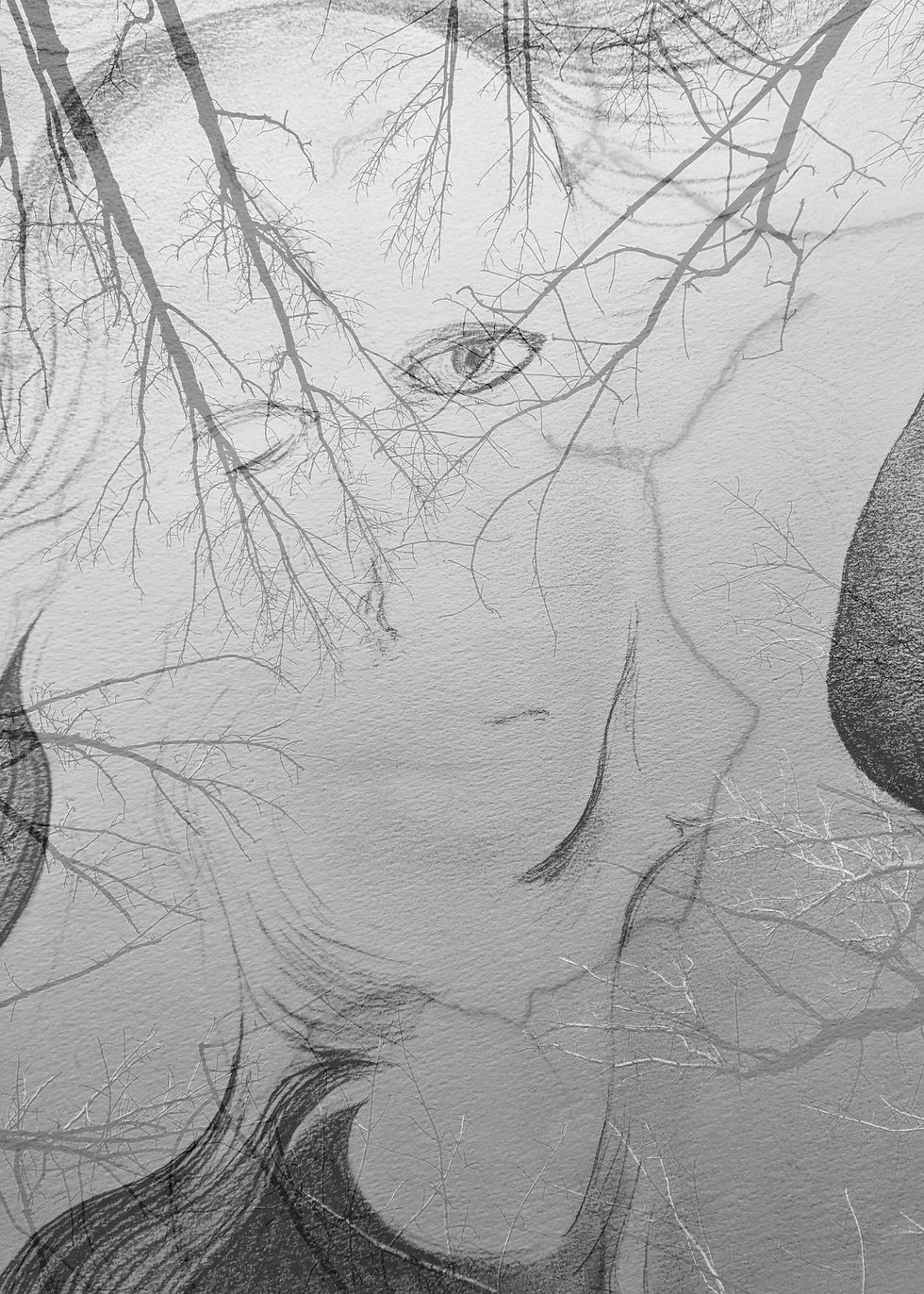
No Say
Strings pull at your arms, legs
Strings reach in through both ears
wind their way
along each fold and crevasse of your brain
– tremble
because you have no say
Strings stretch down past clenched teeth
between your left tonsil and sensitive uvula, down
ridged esophagus and into your heart
Strings weave inside
both atria, both ventricles
veins, arteries
Your heart beats to the pull
of the strings
– tremble
because you have no say
They decide
what is in your heart
They decide
– so, tremble
because you have no say
but, by God, be grateful
Previously published by The Red Penguin Collection and Another New Calligraphy
From the poet and artist:
I drafted the initial form of this poem while living in South Africa and studying pre- through post-Apartheid poetry. The initial version commented on race relations in the country, but I later revised it to reflect on my own experiences and understanding as a member of the LGBTQI+ community. The parallel messages between the two versions were of course strong—how choices and ways of existence for certain individuals or groups can so often be determined for them by someone else or by society as a whole. The poem came home to me when written with the queer lens. I edited to emphasize the puppet strings reaching deep into the heart, and the mention of God at the end took on a specific meaning for me in the queer context.
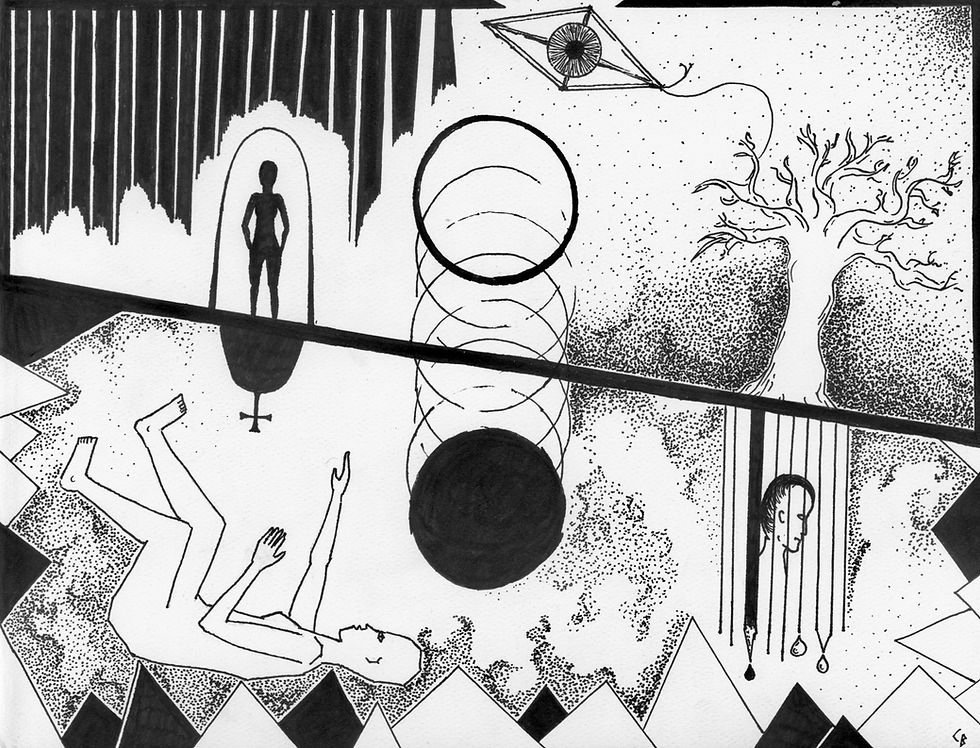
just a body
You feel:
a blow to the side of your head
the prick of a needle through your skin
wind blowing shards of ice against the back of your neck
Your mind
thoughts
feelings
are tuned into your senses
– your body
Your body
is your life
But when that blow knocks you down
and you have the chance to study the rough grain
of the dusty wood floor
when the needle leaves you with a small pool of blood
and that numbing chill that spreads so quickly
like ice across still water
when the wind wrests your warmth away
and you’re left to wonder if the shards
will at last cease to melt on your skin
there comes a sneaking suspicion
– or possibly a lightning-strike epiphany
that
after all
your body
is just a body
Previously published by Another New Calligraphy
Received prize in St. Lawrence University’s annual poetry contest in 2013
From the artist:
The body can handle pain in many forms—abuse, addiction, isolation. We experience something, and the body, in all its resilience, recovers in its own way, and we keep on living. But sometimes, when there’s too much, we become numb. Sometimes we’re knocked to our knees and we stay there. Sometimes it can be hard to remember the resilience of our own bodies, and it becomes strikingly apparent just how breakable we are.
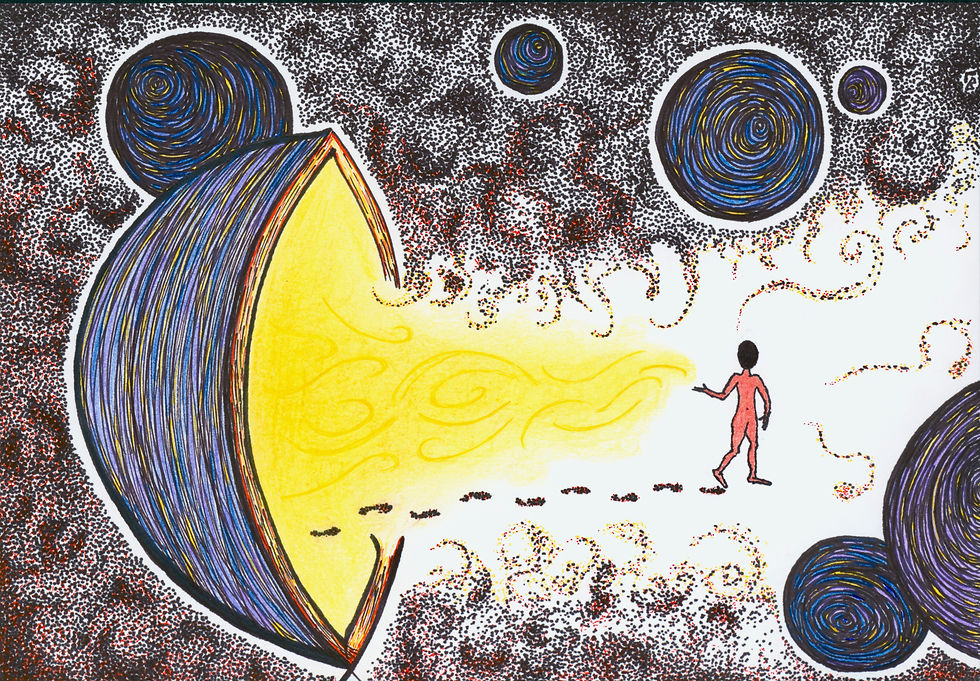
Because the Stars Can Hold Hands
— In memory of R
We hit the universe.
We took off in an incomplete
rocket ship, protected
but headed in directions unknown
– so vulnerable
We took off heading up up and away
but then another Bang
and now we plummet
downwards, sideways, end
over end, lightness of mind
left behind
And while we can slowly
turn our backs to the sun
as apparently certain as the most
solid planet, the sunshine
is eternal, and there is no escape
from the blinding reminder
in the light
We hit the universe.
What once was dust now lingers
swirling in our heads, figures
of the forgotten resurrected
Because there is always
more than one giant rock
in a belt of asteroids
Because the thing about belts
is they tighten, around waist
around throat
around helpless minds
Because we fly solo
and our peripheral can only take so much
There’s a reason we stand at night
gazing at the dark swath, the scattered
stars, with jaws slightly dropped:
it’s terrifying
We’re just one more speck, lost
in that black wasteland
one more dot floating, circling
hanging
But at the same time, we are right where we are
which means we’re not lost
Because the stars can hold hands
Because the turning of the planets
is just a slow dance among friends
Because the sunshine is eternal
but doesn’t always blind us
Without that light
there would be no moon, no reflection
of ourselves, just as alone
to gaze down at us when we need
a breath of fresh air
We can find some gravity
on our directionless journey
We hit the universe
but the sunshine is eternal
so the moon can always return
up above, waiting for us
in its solitude, in ours
even with a smile if it’s not too full
From the artist:
This poem was written following the death of a Peace Corps friend early into our service in Tanzania. It’s about managing grief in a world far away from home, before our roots started holding firm in the foreign soil. It’s about balancing the pursuit of community while navigating loss and managing many levels of loneliness.
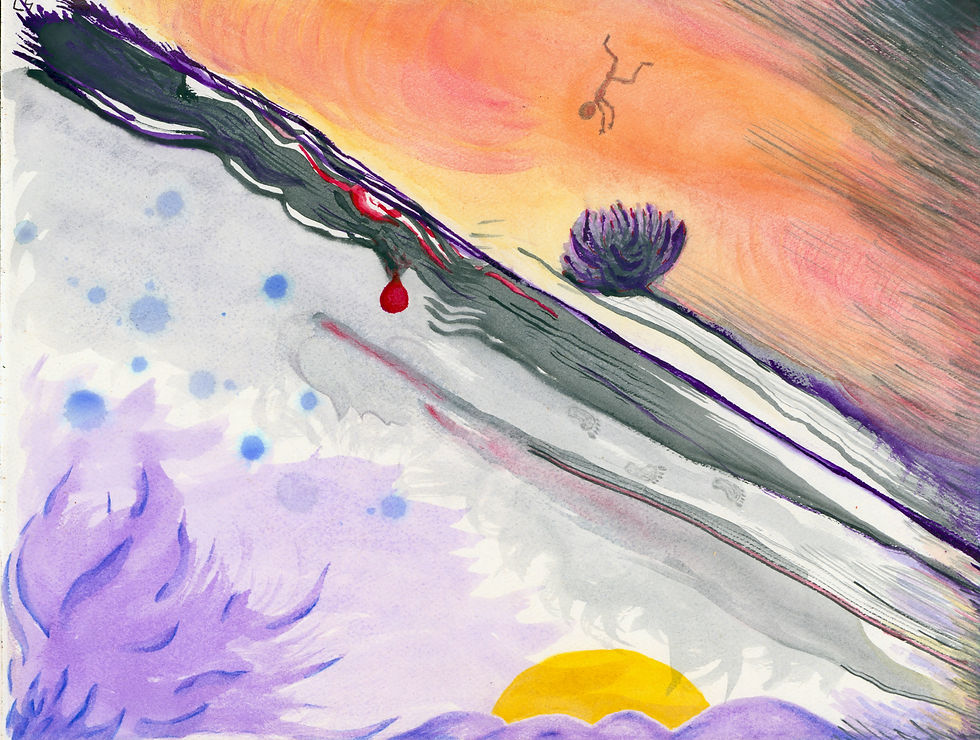
Falling and Flying
Slow the motion of the butterfly’s wings:
it falls between each beat
Sometimes we must lie to ourselves
simply believe we are on the side of angels
ignore why people do what they do
why we do what we do
If we become our obsession
we become our undoing
but sometimes we must allow the world
to strip us of selflessness
Sometimes we must become our obsession
to prevent our undoing
Sometimes regret is a prison
of our own making
Sometimes our freedom must
be of our own making as well
Sometimes we need to love
no matter the consequences
Sometimes we fall between
each beat of our fluttering hearts
But the butterfly is a treasure there to reveal
to help us remember the essential balance
between and flying
falling
From the artist and poet:
This poem was inspired by the study of a butterfly’s wings. When moving through the air, butterflies have an apparently erratic flight pattern. They zigzag and rise and fall in unpredictable ways. This makes them more difficult for predators to catch, but it also makes it seem like they could be in a constant struggle to find the balance between falling and flying—not unlike the human struggle to find the balance between love and loss.
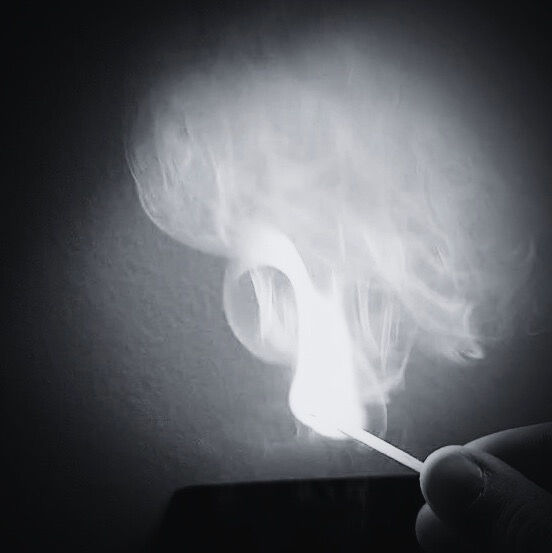
Ashes on the Wind
We believe
in a beyond
to quell our fears
unable to fully face the finality
of our inevitable endings
Heaven above
or the concept of rebirth
serve as a North Star
a reason
to live a life of compassion
But in that mentality
we look for another chapter
await a second chance
Perhaps it’s better
to acknowledge
there won’t be a phoenix
rising from these ashes
Better
to see the scars
given to you and welcome
them to your body as a home
Better
to see the scars you’ve handed out
and ask for forgiveness
from those you’ve injured
from yourself
Our bodies aren’t born again
but that fact
should be our North Star
should be our reason
to love and be loved
to right wrongs
to build our flames
add fuel
because it brings warmth
to the world
At the simple spark of a match
we are meant to transform
to pop and sputter
to smoke and sizzle
to burn down to coals
and turn to ash eventually
But perhaps it’s better to acknowledge
there won’t be a phoenix
rising from these ashes
no freshly feathered wings
in our futures
rather
d i s s i p a t i o n
one final ride
on the wind
From the artist and poet:
It becomes apparent in this poem that I am not a religious person. I am, however, endlessly fascinated by the human desire or need to believe in a beyond, to at times relinquish responsibility to some greater power, to have something to blame when there are no answers, attempt to apply reason to the inexplicable. Life can deal out so many blows, and often the unfairness of them is impossible to wrap one’s head around. There may be no answer, but I do think we all need a North Star.

Flapper Press is always open to new content that provides a unique voice or perspective. We are currently accepting SUBMISSIONS for every category on Flapper Press. If you have questions or would like to submit your work, please carefully review our Submission Guidelines and contact us at: info@flapperpress.com


Comments