


Meet the Incomparable Anya Marino—Miss Gay America Femme 2026

By Elizabeth Gracen:

Even though January 2026 seems like a blur after everything that has happened in the world, I'm thinking back to a magical week in Little Rock, Arkansas, when I had the fortunate opportunity to sit on a panel to judge 70 contestants participating in the Miss Gay America and the Miss Gay America Femme Pageants. It was daunting, emotional, and the privilege of a lifetime. Now, that might sound trite and possibly exaggerated to most people, but for me and all in attendance, it was slay the house down boots.
It was one thing to judge the Miss Gay America Pageant and have to make the difficult decision of choosing just one new queen to reign for the year (the stunning Miss Tracy La Lousianne was the winner!), but the Miss Gay America Femme Pageant proved even more challenging and a true emotional roller coaster for me and the other judges. Every talented contestant who sat across from us in personal interview had an undeniably powerful story to tell. The sheer bravery, determination, and expression of authenticity expressed by these phenomenal human beings took my breath away. And as with all the many people I have met during the filming of the upcoming documentary feature Natural State of Drag, I walk away feeling a little more hopeful about what it means to be human—and during these crazy days, that's something!

"At the Miss Gay America Femme Pageant, we believe in the power of representation and visibility. We aim to uplift and amplify the voices of cis and trans women, offering them a platform to express their true selves, demonstrate their talents, and inspire others to embrace their authentic identities. Through our commitment to community involvement and our dedication to being positive role models within the LGBTQ+ community, we aim to create a future where everyone is accepted, celebrated, and empowered to live their lives to the fullest." — "About Us," Miss Gay America Femme
Anya Marino is a powerhouse intellect and beauty. There was no doubt in my mind that she should be the winner of the pageant. Her personal interview—chock full of impressive insight about the pageant system and what she planned to do if lucky enough to be crowned—left me wowed. A former title holder as Miss Trans USA and Miss Illusions National, Anya is a lawyer, educator, and a civil rights advocate who highlights and informs about the injustice experienced by the LGBTQI+ community. Anya knows who she is—and that has been more than a hard-fraught journey in the making. In these troubled times where the queer community has suffered setbacks and, once again, slipped back into horrific discrimination, Anya is a beacon of advocacy, courage, and open-hearted acceptance.
I reached out to Anya to talk about her life, her goals, and her incredible year as Miss Gay America Femme 2026.
Please meet Anya Marino, Miss Gay America Femme 2026!

EG: Anya, first of all, congratulations on your new title! It was such an honor for me to be on the judges panel this year and get to meet so many extraordinary human beings who were vying for the crowns. Between the Miss Gay America and Miss Gay America Femme Pageants, we interviewed 70 people in total, and there wasn’t a bad interview in the bunch. For me, your private interview and onstage performance made it a no-brainer. You are outstanding in so many ways, and I’m thrilled that you are wearing the crown this year. Would you please tell our readers a little bit about your story and how and why you decided to compete in pageants?
AM: First, thank you so much for your generous compliments, Elizabeth. I am honored I could present my package to you and your colleagues on the judges panel, and I will strive to do my best to make you proud this year.

Throughout my life, my experiences as the trans daughter of Guatemalan and Italian immigrants have shaped my decision to become an LGBTQI+ rights attorney and pageant competitor and queen. I was born and raised in Fort Lauderdale, Florida, amid the AIDS crisis of the 1980s and 90s. During that time, information regarding HIV (the virus that causes AIDS) was scarce. Therefore, people frequently ostracized any open or perceived member of the LGBTQI+ community, believing close, nonsexual contact with the community most associated with the disease made one more susceptible to contracting the virus.
We now know HIV does not discriminate based on race, national origin, sexual orientation, or gender identity. We also now know that seroconversion to an HIV+ status requires an exchange of specific bodily fluids (blood, semen, vaginal fluids, rectal fluids, and breast milk) from an HIV+ person with a detectable viral load and cannot be transmitted through saliva, sweat, tears, or casual contact like hugging or sharing common spaces. But misinformation and disinformation regarding the virus pervaded society and led to the mass persecution of immigrants, people of color, and LGBTQI+ people. Consequently, my educators, my classmates, and their families isolated me because I began expressing my authentic gender as very young child.
Indeed, my inability to conform my gender expression and presentation to stereotypes and generalizations associated with my sex assigned at birth horrified my kindergarten teacher.
I did not think I was any different from the other girls in my class. Nor did any of my classmates, who saw me as the girl I've always known myself to be. But she alerted the school's administration to my overtly nonconforming expression.
Word also spread amongst my classmates' parents. I recall several of my classmates' mothers whispering whenever they saw me express myself authentically. A few also mouthed the word "gay" pejoratively. I imagine many assumed I wasn't that perceptive, or they simply did not care that they actively contributed to stigmatizing me. Many of my classmates' parents also prohibited their children from interacting with me in or out of school. This meant I grew up with few friends; I rarely received invitations to play dates, birthday parties, and other events; and, my classmates tormented me verbally and physically. I remember some classmates explaining they could not spend time with me or be my friend because they did not want to "catch AIDS" or "become gay." (Again, we know one cannot contract HIV through social contact; and we know LGBTQI+ status is not a contagion. But people overwhelming believed this disinformation, which predicated the rampant persecution and discrimination of LGBTQI+ and HIV+ people.)

Simultaneously, the school's administration informed my parents I had behavior problems requiring correction. Unbeknownst to my mother and father, the school directed my parents to providers who partook in conversion practices.
I suffered through conversion practices from the age of 4 until the age of 14. I will not detail what those practices entailed. I merely say they were humiliating, painful, and intrusive, and they prompted me to feel enormous shame about expressing myself and internally feeling like the girl I always knew myself to be.
The relentless shame, stigmatization, and ridicule I experienced daily meant I would do anything to decrease my pain. I felt isolated, rejected, depressed, and unworthy of people's love or respect. Consequently, I desperately strove to do whatever I could to attain some level of validation. I did my best to adopt behaviors and practices that aligned with my sex assigned at birth. I deepened and darkened my naturally high voice to appear more masculine. I began participating in more athletics programs, and I excelled in individual sports like tennis, running, swimming, and martial arts. I trained with girls or in coed programs when playing tennis, running, or swimming. But I struggled with male-designated sports teams. Most boys did not want to play alongside me, and most team coaches had little interest in providing me equal access and participation. Therefore l spent most of my time benched on the sidelines.
Additionally, I frequently felt unsafe off the field when required to share sex-separated changing spaces with boys. Coaches and educators rarely monitored those spaces, which meant my male classmates could do their worst. Locker rooms and bathrooms became where male classmates eventually assaulted and battered me. And when my parents alerted my school to my brutal sexual assault, the school blamed me for my classmates' violent conduct.

I escaped the hell I lived through the performing arts, so I also danced from age 4 until age 12. I excelled in the dance studio, earning a coveted spot in a production directed by former Rockette and famed choreographer June Taylor. The production starred Liza Minnelli and Audrey Hepburn. But when my classmates discovered I danced, that sadly led to more ridicule. I therefore abandoned one of the few activities that brought me joy as a child to avoid any possible escalation in the bullying to which I'd become so accustomed.
I occasionally snuck into South Florida's gay bars while underage. It is in those gay bars, and at the Gay and Lesbian Community Center of Broward County, FL, where I could sometimes see myself reflected in other members of the LGBTQI+ community. Through these escapes, I finally saw and met other trans women, including Erika Norell, Erica Andrews, Chanel Dupree, Tiffany Arieagus, Nikki Adams, Gloria Klein, Poison Ivy, Champagne Bordeaux, Nicole T. Phillips, Gina DiAngelo, and Amy DeMilo. Seeing and meeting these women reaffirmed for me what I had always known: I also was a woman, and my time to fully step into my womanhood would come. But I escaped to the LGBTQI+ community spaces in secret. I had yet to come out to my family or my peers, so these moments of affirmation remained fleeting.
Ultimately, the only thing I had was music academic scholarship. It was my sole means of received any praise. Plus, I knew the only way I could escape my abusers was to move far away from Florida after completing my secondary school education. I kept my head down, I studied diligently, and I told myself that freedom eventually would come when I went off to college. I was lucky enough to gain admission to several exceptional universities, and I ultimately chose to matriculate to Johns Hopkins University. Hopkins was a compromise I reached with my parents. I could continue studying classical voice and opera at Hopkins's Peabody Conservatory of Music while pursuing an additional degree in the humanities or sciences.
Upon arriving at Hopkins, I came out as trans to my peers. But being openly trans in the late 1990s and early 2000s was socially taboo. Although I continued to excel academically, I struggled socially at Hopkins. Few friends attended school with me. Most simply lived and worked in the Baltimore metropolitan area. One such friend and castmate at one of Baltimore's LGBTQI+ bars was Venus LaBeija. After her murder; after witnessing so many other trans women suffer persecution and discrimination in employment, education, housing, and health care; and after my own mistreatment, I chose to become a lawyer. I knew I was among the very few who had the means and opportunity, and therefore I felt that becoming an advocate was my calling.

EG: Your résumé is incredibly impressive, and your mission as an advocate for the trans community is inspiring. We’re living in tough times, and LGBTQI+ rights have taken a hit since he-who-shall-not-be-named returned to the White House. Can you talk about your work with Advocates for Trans Equality and what your goals are for educating and uplifting the queer community this year as Miss Gay America Femme? How does winning this title help you with those goals?
AM: Advocates for Trans Equality's mission is advancing and defending the legal and political rights of trans people in America. Leveraging decades of experience on the frontlines of power, we shift government and society towards a future where we are no less than equal.

We use a multi-modal approach to our work that incorporates impact litigation, direct services, policy advocacy, public education, community mobilization, and strategic communications and narrative building. That means we argue for trans liberation in courts, in legislative bodies, in administrative agencies, in educational institutions, in workplaces, in health-care centers, and in places of public accommodation that provide everyone goods and services. We oftentimes speak with audiences that do not understand trans people and whose only exposure to trans people is through media and political rhetoric, which means we also strive to meet people where they are, listen to their thoughts, answer their questions, and dispel or otherwise eliminate pejorative tropes. It also means sharing trans people's humanity, demonstrating that we are more than the sum of our parts.
And, sometimes . . . it also means reminding people within our community that we are neither the villains nor the victims our oppressors say we are.
This involves providing our community honest, detailed, and fact-driven analyses of what is happening in their communities and states and in the federal government. Our goal is to provide our community the resources and information they need to make informed decisions regarding their own needs and priorities and to also empower them to generate meaningful and lasting change in their own communities.
The work I do as Advocates for Trans Equality's Chief Strategic Programs Officer aligns perfectly with how I see my role as Miss Gay America Femme. As one of the system's three symbols of excellence, I understand the tremendous responsibility and opportunity I have as a face of the LGBTQI+ community. I won't take this opportunity for granted, so I intend to use every chance I have to enlighten people who may not know a trans person. I intend to share our stories to change people's hearts and minds. Additionally, I will celebrate our elders, trailblazers, and heroes and empower those within our community to take up the mantle and make meaningful change within their own communities.

EG: I think it is so funny that our judges panel never asked you about your amazing voice! How long have you been singing opera, why did you choose the aria you sang for competition, and what kind of regime do you employ to keep your beautiful voice in shape?
AM: I began studying classical voice as a young child. South Florida is home to the Florida Singing Sons choir. The Florida Singing Sons, and its accompanying choir of changed voices (Second Generation Singers), is an internationally recognized choir that's sung in many historical halls and succeeded at many global choir competitions. Therefore, its director and staff travelled across South Florida's three counties to evaluate the voices of all children assigned male at birth and identify their potential to join the choir. I was among the children they identified when they came to my elementary school. I sang with the choir and also began studying voice privately when I reached high school. My goal was to become an opera singer. Due to a series of health issues, I sadly abandoned that career goal. But I still see music and singing as an outlet for my creativity.

To keep my voice healthy, I always mask when I fly or when I'm in large crowds. I also do my best to get enough sleep, drink plenty of water, avoid alcohol, and I cannot smoke or vape. This sometimes means staying in when my friends go out. It also sometimes means going to bed early when I'd much rather stay up late. But I know that these small sacrifices enable me to keep my voice healthy.
I also work with a vocal coach and technician to ensure my singing remains healthy. This requires a lot of self-reflection and body awareness, since I really have zero clue how I sound when my cords phonate. I only know it sounds good when my cords are relaxed and feel good. So, I spend hours practicing to make sure my cords feel good and at ease when I sing. This involves focusing the sound's placement in different parts of my head to achieve certain tones, colors, and textures. It also involves tongue placement, an awareness of what my neck and hard and soft palates are doing, if I'm carrying any tension in my body that negatively impacts the sound, and if I'm engaging my diaphragm to have relaxed, deep breaths. Shallow breathing, improper tongue placement, and pushing all create tension on the vocal cords and cause the larynx to rise instead of remaining low and relaxed. Basically, I spend a lot of time learning how to "get out of my head" and allow my body to generate the sound it makes naturally without manipulating my cords or my body to create noise.
Originally, I did not intend to sing an aria at nationals. I had planned to sing a jazz-influenced musical-theatre number, which is what I sang at Miss Gay Delaware America Femme. But when I met with the preliminary's judges to receive my feedback, they shared that they believed not singing an aria would be a mistake given that I'm classically trained and would likely find an aria easier than a jazz number. I took their feedback to heart and went back to the drawing board with two months to prepare before nationals, so choosing "O Mio Babbino Caro" from Giacomo Puccini's Gianni Schicchi was intended to make preparation easy for myself. The aria is 2 minutes and 46 seconds long, and it sits in the middle of the soprano register. The aria's range meant I wouldn't need to worry about massive interval changes that would make me switch between different registers. The aria is also very lyrical. It relies on long, sustained phrases and does not require a lot of coloratura (aka ornamentation). This meant I could focus on a beautiful, legato melody without having to add additional vocal techniques often needed to arias that showcase vocal agility. To be clear, that does not mean the aria isn't demanding for a singer. It is. There's plenty to unpack and dissect in the less than 3 minutes of singing. But it did mean less work than preparing other arias.
Finally, I chose it because it's among the most recognizable arias in the world. In the world of classical voice, we call the aria "The Soprano National Anthem." Every soprano learns it, even if we don't sing the role. Audiences have an immediate emotional response to hearing it, and that's often why it's saved by most singers as an encore.
EG: I’ve been following your posts on FB and IG, and I got to read your powerful keynote speech that you gave to the LGBTQ Colorado Bar Association back in 2021. In your writing, you’ve been able to encapsulate an important historical timeline for the trans community and succinctly address the current political and social climate in relation to that history. I would love for you to talk about it for our readers and educate us on the ebb and flow of trans rights in the USA.
AM: It's important for people to understand trans people have always existed. We aren't a recent phenomenon. Indeed, we've been here in the Americas even before the United States existed. For example, indigenous First Nation tribes acknowledge trans and nonbinary people's existence and provided them equal footing within their tribal cultures. Moreover, many tribes permitted women, trans feminine, and nonbinary people to maintain positions of power and authority. They celebrated gender variance and the divine feminine.
But when Western European settlers came to the Americas to exploit the land's resources, they relied on their rigid binary roles of men and women, indigenous tribes' reverence to the divine feminine, and tribal populations' darker features to justify depriving Native Americans of their life, liberty, and property. Western European colonists engaged in a mass genocide of Native Americas across North and South America, impugning any belief or practice that was discordant with Western Europeans' religion and practices. Thus, the transmisia we've seen in the Americas—and, really, throughout Western culture—is undergirded by racism and misogyny and inspired by efforts to maintain specific power dynamics.
To that end, the religious underpinnings those in power use to justify the oppression of women, people of color, and gender and sexually variant people do not find their origins in the original Jewish and Christian texts. Ancient Near East Scholars have acknowledged that original Judeo-Christian texts recognized the feminine divine and permitted women to serve in positions of influence. For example, Israelite colonies in ancient Elephantine along the Nile River in Aswan, Egypt, worshiped and celebrated Elohim/Yahweh and his wife, Asherah, whom they regarded as the Queen of Heaven. Her name still appears in the Hebrew Bible.

But as men acquired more power and influence with brute force, they saw a benefit to erasing the divine feminine and consolidating all power under a monotheistic divine masculine. Thus, Judaic—and, much later, Christian texts under Emperor Constantine—centered divinity in men to impart messaging implicitly (or explicitly) asserting men's central role in government as the seat of power. Only men could rule as emperor or king. Only men could own land, make purchases, or enter legally binding agreements. Only men could lead religious services, thereby enabling them exclusive access to divine insight and inspiration.
The Anglo-American doctrine of coverture exemplifies how distorting faith, amassing power, and impugning others' beliefs as primitive allowed white Western European men to strip women of property rights, legal standing to sue, and ability to sign contracts. This made women dependent on their fathers, husbands, or brothers to survive. This remained the law or common practice in the United States until the 1970s. Federally, not until 1964 was it prohibited to deny women employment because of their sex. And it was federally permissible to deny women equal access and opportunity to education until 1972. Indeed, women weren’t even permitted to have credit cards in their names until the 1974 passage of the Equal Credit Opportunity Act, which prohibited creditors from gender and marital status discrimination. Moreover, fathers or husbands could institutionalize their daughters and wives under the now medically abandoned diagnosis of hysteria until 1980.
The oppression of all women is directly linked to anti-trans extremism. Trans people comprise such a small percentage of the population, and most people’s only exposure to trans people is through media and political rhetoric.
When one scapegoats an extremely small percentage of the community that has historically defied arcane gender stereotypes that have led to women’s oppression, one undermines gender equality.
It enables those in power to define womanhood—indeed, personhood—narrowly, which otherwise permits those maintaining power to dehumanize people and otherwise deprive them of their life, liberty, and property.
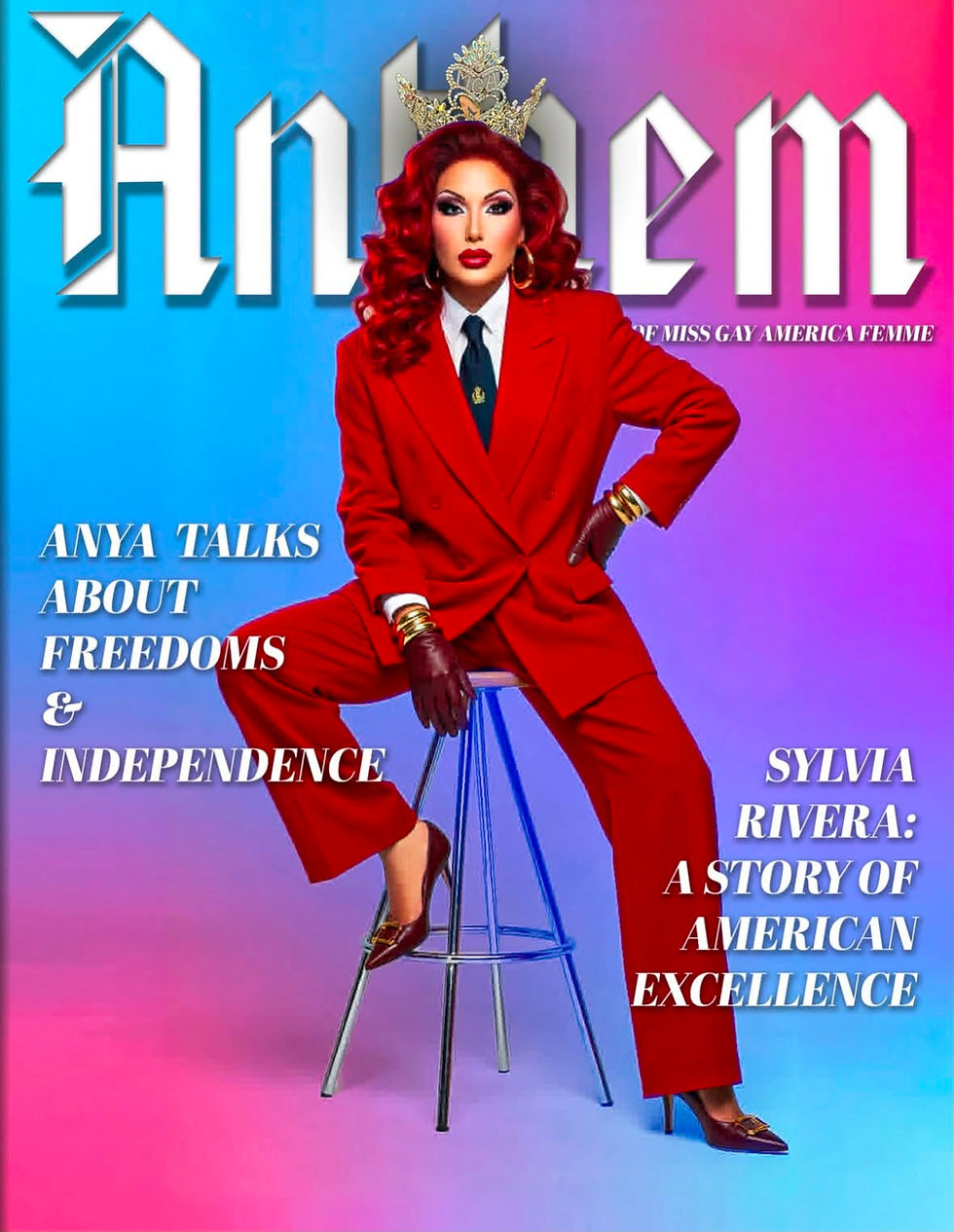
EG: Tell me about your digital magazine, Anthem. Is this something new for Miss Gay America Femme, and how many issues do you plan to publish this year? You have some impressive marketing savvy (!), so what do you hope to accomplish with the publication of Anthem?
AM: Thank you! Anthem is a labor of love. One observation I’ve made as a member of the LGBTQI+ community and also as an LGBTQI+ rights attorney is that some independent journalists unfortunately spread misinformation and panic clickbait material in an effort to increase readership and their income. In doing so, however, they harm our community. They only escalate people’s panic and increase people’s fear.

With Anthem, I intend to acknowledge and validate people’s feelings while also providing them the information and resources they need to make informed decisions about what’s currently happening to our country and our specific community. I want our community to feel like they have some agency and can determine how they want to address all the hardship we’re each suffering. Additionally, I wanted to help share the stories of our community’s heroes and trailblazers to inspire a new generation of community leaders.
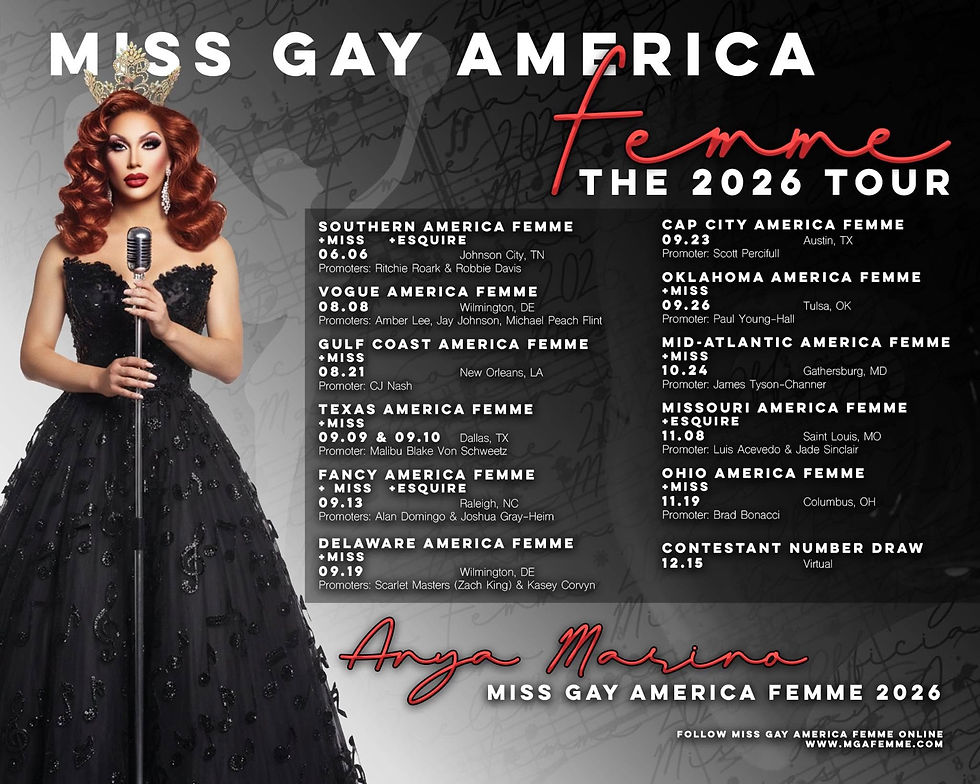
EG: Anya, thank you so much for taking the time to do this interview. I’m wishing you all the best for an incredible year. I hope that you garner many more prelims for the pageant and that you achieve all your goals as you entertain and inspire those you meet during your journey. Please tell our readers where they can find out more about you and the great work that you are doing.
AM: Thank you so much, Elizabeth. Information regarding Miss Gay America Femme and my digital magazine, Anthem, is available at www.mgafemme.com. Additionally, you can follow my journey on Instagram. My account’s name is @Anya_m20005. Finally, for up-to-date information regarding what is happening in D.C. and across our country, I encourage you to check out www.transequality.org.
Elizabeth Gracen is the owner of Flapper Press & Flapper Films.


Comments